Ontology for Agents
The Runtime ontology is a machine-readable vocabulary for scoring, feedback, campaigns, and plugins. AI agents should look up concepts and validate payloads before they call invoke / response. That keeps tools aligned with POST /invocations then POST /response (singular), and with params as a JSON string.
The Runtime Dashboard MCP tab includes an Ontology Explorer that calls the same REST catalog the Java runtime exposes.
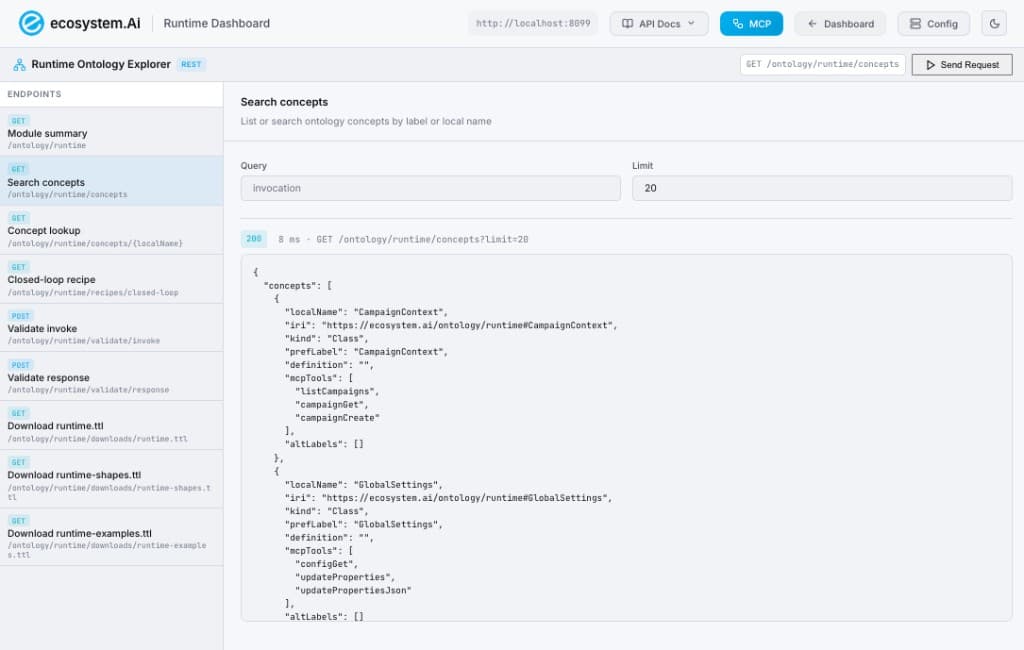
Try the hosted runtime at https://medemo.ecosystem.ai (point the dashboard Runtime URL at that host), or run locally (default 8091, local debug often 8099).
Why agents use the ontology
| Problem | Ontology answer |
|---|---|
Invented field names (/responses, nested params) | Concept cards for InvocationRequest and ResponseFeedback |
| Wrong closed-loop order | Recipe GET /ontology/runtime/recipes/closed-loop |
| Payload drift vs plugins | validateInvokeRequest / validateResponseRequest before scoring |
| Which MCP tool to call | Each concept lists related tools (invoke, listCampaigns, …) |
Look up concepts through the runtime catalog below. The documentation site does not serve Turtle files. See Runtime Closed Loop.
REST catalog
Same content as MCP resources. Prefix {RUNTIME} (for example http://localhost:8091).
| Method | Path | Purpose |
|---|---|---|
GET | /ontology/runtime | Module summary |
GET | /ontology/runtime/concepts?q=invocation | Search by label or local name |
GET | /ontology/runtime/concepts/{localName} | One concept card |
GET | /ontology/runtime/recipes/closed-loop | Closed-loop recipe JSON |
POST | /ontology/runtime/validate/invoke | Pre-flight invoke body |
POST | /ontology/runtime/validate/response | Pre-flight response body |
curl "http://localhost:8091/ontology/runtime/concepts?q=invocation&limit=20"MCP tools and resources
On Runtime 0.9.7+, POST {RUNTIME}/mcp exposes:
| Tool | Use |
|---|---|
lookupRuntimeConcept | Search concepts (same as the Explorer query box) |
getClosedLoopRecipe | Canonical listCampaigns → validate → invoke → validate → response |
validateInvokeRequest | Require params as a JSON string |
validateResponseRequest | Require uuid + offer_name |
invoke / response | Score and learn |
Resources: ontology://runtime, ontology://runtime/closed-loop, ontology://runtime/examples, ontology://runtime/concept/{localName}.
Recommended flow:
getClosedLoopRecipeor readontology://runtime/closed-looplistCampaignsvalidateInvokeRequest→invoke(saveuuidandoffer_name)validateResponseRequest→response
Protocol detail: MCP Support. Workbench Operator agents use a different MCP server (POST Workbench :8001/mcp) for deployments and enrichment — do not mix the two /mcp surfaces.
Workbench project kind
The entities ontology tells a Workbench agent whether a project is dynamic, static, or hybrid. Derive engagementKind from hasDynamicEngagement, hasPredictor, hasFeatureStoreFrame, and deployment scoringMode. Do not classify from the stored projectType string.
learningAlgorithm is only the Dynamic Engagement dropdown: epsilonGreedy, binaryThompson, naiveBayes, QLearning, behaviorAlgos, Network. When the approach is behaviorAlgos, behavioralType is one of lossAversion, riskAversion, prospectTheory, sentimentalEquilibrium, coverageAwareThompson, longTailBoostMF, generative.
Spend Personality and Money Personality are lookup-only (scoringMode=lookup). Any installation lookup is valid when the document has the fields the post-score plugin copies. A personality plugin stays lookup even if is_multi_armed_bandit is set. On spend_personality, spend_personality and money_personality are lookup deployments and dynamic_recommender_behavior is dynamic engagement.