Runtime Dashboard
The Runtime Dashboard is the tester UI that ships with Runtime 0.9.7.0. Use it to ping the endpoint, pick a campaign, call POST /invocations, accept an offer with POST /response, and open the MCP, ontology, and campaign-test surfaces without writing cURL.
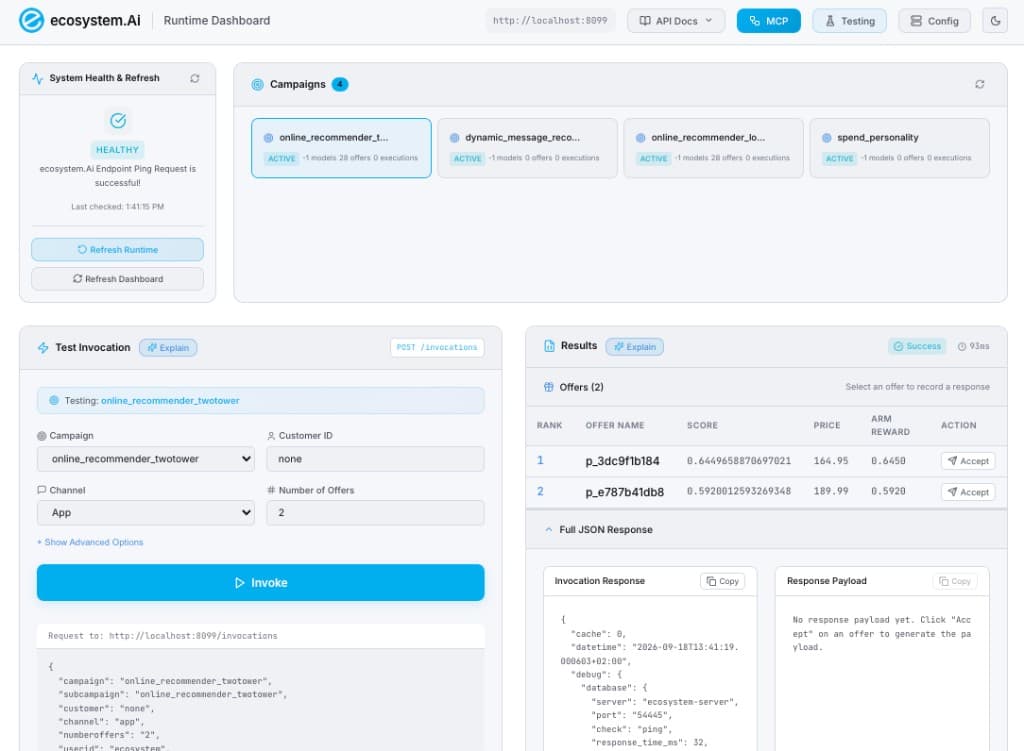
Hosted demo: https://medemo.ecosystem.ai . Point the dashboard Runtime URL at a running Java runtime (default scoring port 8091; local run_local.sh often uses 8099). The separate Vite app in ecosystem-runtime/frontend serves the same UI on :3000 during development and proxies API calls to the runtime.
What it is for
| Surface | What you do |
|---|---|
| System Health | Ping the runtime; refresh campaign configs |
| Campaigns | Select an active campaign (predictor name) |
| Test Invocation | Build a closed-loop request and Invoke |
| Results | Ranked final_result rows; Accept writes /response |
| MCP | JSON-RPC POST /mcp, Ontology Explorer, prompts |
| Testing | Properties-driven Cucumber / BDD campaign tests |
| Config | Runtime URL and dashboard settings |
This is an operator / developer console. Production traffic should still call /invocations and /response from your channel (app, web, call center) with params as a JSON string.
Debug explanations
Turn Debug on (Workbench Test defaults it on) so /invocations returns debug.explanations: short operator-facing titles, what happened, and what to do. The dashboard Results panel and Workbench Debug analysis tab both render that list. Typical codes include MONGO_LOOKUP_NULL, EMPTY_OFFERS_CONTEXT, CONTEXT_DEFAULTED (API omitted both contextual variables, so scoring used the first options-store cell), and SCORED_OFFERS.
Closed loop from the UI
- Choose a campaign, customer, channel, and number of offers.
- Invoke sends
POST /invocations. The request preview at the bottom of the form is the payload your app should send. - Ranked offers appear with score, price, and arm reward.
- Accept on a row sends
POST /responsewith that row’suuidandoffer_name. That is the learning feedback — never/responses.
{
  "campaign": "online_recommender_twotower",
  "subcampaign": "online_recommender_twotower",
  "customer": "none",
  "channel": "app",
  "numberoffers": "2",
  "userid": "ecosystem",
  "params": "{}"
}
params must stay a string ("{}" or a JSON-encoded object). Nested JSON objects in params are rejected.
Related
- API Access — REST
/invocationsand/response - MCP Support — agent tools on
POST /mcp - Ontology for agents — concept catalog the MCP tab explores
- Campaign testing — BDD runner on the Testing tab